
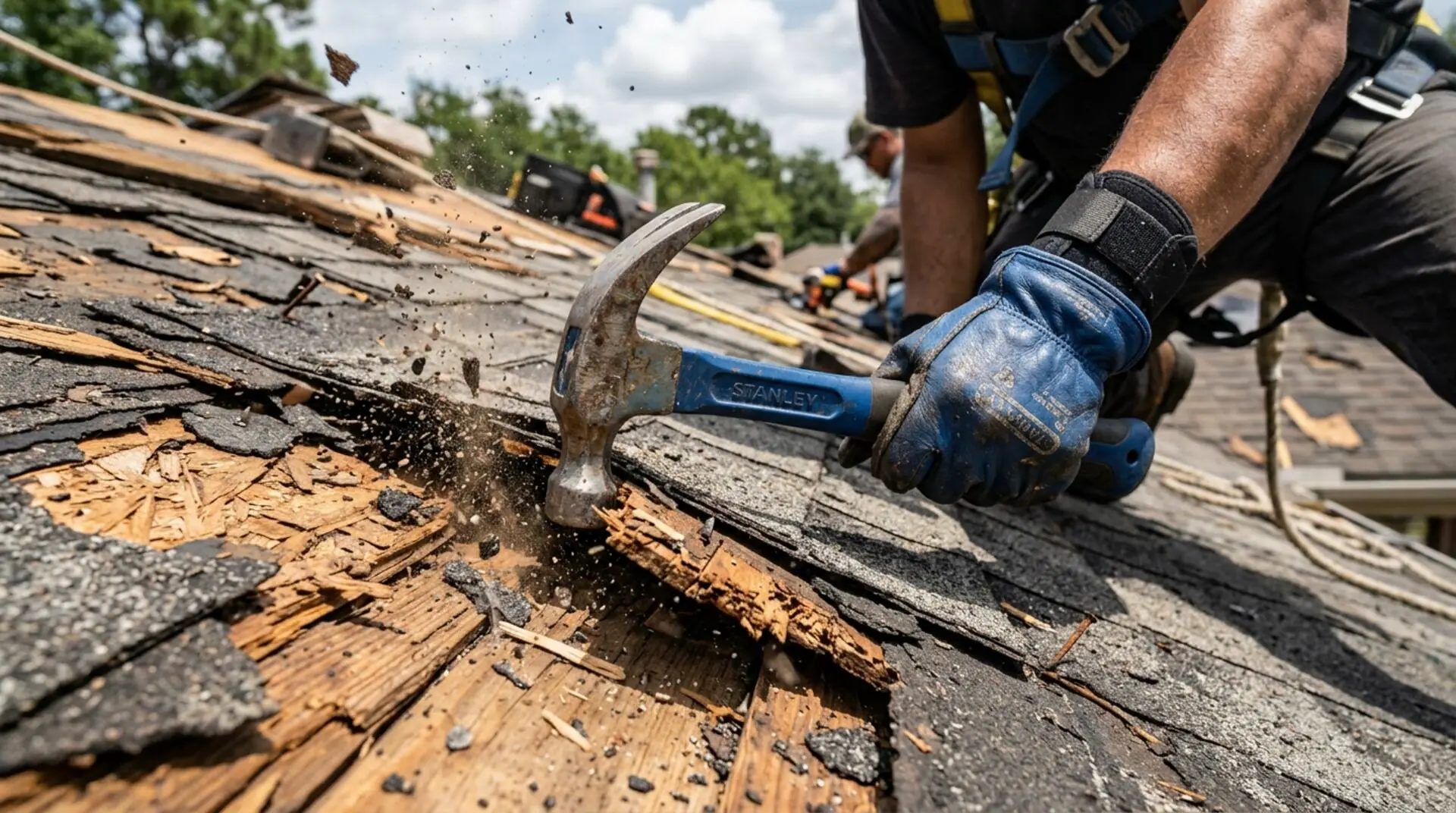
Water rarely enters directly above where it drips. In Houston's humid, storm-battered climate, moisture can travel along rafters, decking joints, and plumbing pipes before surfacing on your ceiling drywall. Our roofing inspectors track leaks from the interior sheetrock back to the exterior structural penetration, providing pinpoint diagnosis before minor water damage ruins your home.
Complete the details below to schedule an on-site physical roof assessment with an inspector.
A water stain in your living room or bedroom is rarely directly underneath the roof puncture. Water flows downward along gravity paths, pooling over drywall screws until the sheetrock softens. Look for these critical warning signs across your Houston property.
Discolored yellow or brown rings on ceilings indicate moisture pooling on the upper drywall face. Even if dry to the touch today, these rings mark recurring saturation points that weaken structural gypsum during subsequent rain events.
When roof leaks run down exterior wall framing, moisture becomes trapped behind latex wall paint. Bubbling paint, peeling drywall seam tape, and sagging corner beads signal water traveling vertically down wall studs from the roofline above.
Houston's relentless humidity amplifies microbial growth. If your attic smells damp or musty, fiberglass batts and blown-in cellulose are likely absorbing rainwater, compressing under moisture weight, and breeding hidden mildew.
Heavy granule buildup in gutters reveals protective asphalt loss. When granules wash away, bare shingle asphalt is exposed to harsh Texas UV rays, leading to hairline cracks, curled shingle tabs, and micro-fissure water intrusion.
Metal flashing seals critical roof transitions around dormers, sidewalls, and parapets. When temperature fluctuations break caulking bonds or rusted nails back out, water channels directly behind the siding and into interior wall cavities.
If your home only leaks during severe Gulf squalls or heavy tropical thunderstorms, high wind shear is forcing rainwater sideways under shingle laps or into unbaffled ridge vents that hold up under normal vertical rain.
Houston roofing systems face extreme environmental stress found almost nowhere else in North America. Understanding the unique climatic conditions helps explain why standard factory seals fail prematurely across Harris County.
In over 70% of residential inspections, failed plumbing pipe boots and chimney flashing are the most common entry points we find in Houston. Standard neoprene rubber pipe collars bake under 100°F+ Texas summer sun, drying out and splitting after just 5 to 7 years. Meanwhile, masonry chimneys expand and contract at different rates than surrounding asphalt shingles, ripping mortar joints and counter-flashing seals wide open. For dedicated chimney repairs, visit our chimney flashing repair service.
Houston's subtropical moisture levels keep the air near saturation for months. When humid air enters an improperly vented attic, it condenses against cool structural timber and underside decking nails. Over time, persistent condensation mirrors roof leaks, rusting fasteners and producing sheetrock stains even without an active puncture.
Tropical depressions, convective supercells, and Gulf squalls regularly dump two or more inches of water per hour. When roof drainage planes are overwhelmed, water backs up behind shingle edges and overflows standard gutter drop outlets, testing every joint in your roofing system.
On a midsummer afternoon, Houston roof deck temperatures reach 150°F before a sudden 75°F thunderstorm deluge rapidly cools the surface in minutes. This violent thermal cycle causes shingles, flashing metals, and elastomeric caulking to contract rapidly, splitting brittle caulking beads and tearing underlayment seams.
Houston neighborhoods like Memorial, Spring Branch, The Woodlands, and Kingwood are covered in mature live oaks and loblolly pines. Falling needles, leaves, and moss accumulate in low-slope valleys, creating organic dams. During rainstorms, these dams back up water uphill underneath adjacent shingles, soaking the plywood decking beneath. If storm winds have damaged your shingles, check our hail damage repair and roof repair pages.
We do not guess where your leak originates. Our technicians employ a rigorous, non-invasive five-step diagnostic framework that follows the path of water from interior manifestation to exterior structural penetration.
We begin inside your home, measuring ceiling moisture and accessing the attic crawlspace. We trace rafter lumber, inspect insulation dampness, and follow water trails back along trusses to where water first breached the wood roof deck.
Climbing onto the roof above the suspected attic intrusion zone, we conduct a forensic inspection of shingle seals, nail placements, step flashing, plumbing pipe collars, valleys, and skylight curbs within a 15-foot radius.
For intermittent or elusive leaks, we perform controlled low-pressure water simulation. Starting at the lowest slope elevation and working upward section by section, we isolate individual roof planes to recreate the exact leak condition.
Using non-invasive electronic moisture detection equipment across the roof surface, we map out the perimeter of saturated plywood decking beneath the shingles. This ensures rotted or compromised wood decking is identified without requiring premature roof teardowns.
We produce date-stamped, high-resolution photographs documenting the precise point of water intrusion. You receive a complete digital diagnostic report illustrating the failure mechanism, accompanied by an upfront, itemized repair estimate.
Homeowners often ask whether they need targeted leak detection or our general roof inspection. Here is a transparent breakdown of the scope, equipment, and objectives of each service.
A targeted forensic investigation designed specifically for properties experiencing active water penetration, ceiling water rings, or unconfirmed water intrusion.
A macro-level wellness check of your overall roofing system, assessing age, storm impact history, and remaining material lifespan. Learn more on our free roof inspection page.
Locating the leak is only half the battle. Once we pinpoint the entry point, we provide honest recommendations tailored to your roof’s age, structural condition, and budget.
When the surrounding shingles and decking remain sound, a surgical repair is the fastest, most cost-effective path forward. We replace cracked pipe boots with heavy-duty silicone units, re-flash chimney saddles, reseal step flashing, and patch localized shingle tabs to restore complete watertight integrity. See our roof repair Houston options.
If your asphalt shingle roof is under 12 years old with isolated damage, repair is almost always recommended. However, if your roof exceeds 15 years, exhibits widespread granule loss, or has multiple leaks across different slopes, patching becomes a temporary band-aid. We explain the economics clearly so you make the best decision for your home.
When forensic tracing reveals the leak was initiated by wind uplift, hail fractures, or flying debris during a recent Texas storm, homeowners insurance often covers the restoration. As inspectors, we document the damage with date-stamped photo logs and meet your adjuster on the roof. Learn more about storm damage roofing.
We believe in upfront, transparent pricing with no hidden charges. Below are typical cost ranges for professional leak detection and localized repairs across the Greater Houston area.
| Service Type | Typical Scope | Houston Price Range |
|---|---|---|
| Diagnostic Leak Investigation | Attic rafter tracing, roof surface inspection & moisture mapping | $175 – $350 |
| Minor Pipe Boot / Seal Repair | Replacement of sun-rotted rubber collar, new flashing & sealants | $350 – $650 |
| Flashing & Valley Overhaul | Rebuilding rusted valley metal, step flashing reset & ice/water barrier | $650 – $1,250 |
| Chimney Flashing Rebuild | Custom counter-flashing, step flashing, reglet cutting & cricket rebuild | $850 – $1,800 |
| Decking Replacement & Patch | Removal of rotted plywood deck sections, underlayment & shingle weave | $750 – $1,600 |
When you hire Epic Roofing & Construction LLC to perform the recommended roof repair, 100% of your initial leak detection fee is credited directly toward your repair invoice. You never pay twice for our diagnostic expertise.
Here are three actual diagnostic cases where our inspectors tracked elusive ceiling leaks back to their exact origin across Houston neighborhoods.
A homeowner reported a recurring dining room ceiling drip that occurred only during violent thunderstorms. Two previous contractors failed to locate the cause because standard shingles appeared intact. Our attic tracing revealed water was entering 14 feet uphill at a second-story dormer transition, where wind was forcing rain behind reverse-lapped apron flashing.
Yellow staining appeared along the base of a master bedroom wall. The homeowner suspected plumbing failure inside the wall cavity. Our inspector tracked moisture up the stud bay into the attic, locating a cracked neoprene rubber collar on an HVAC exhaust vent stack whose seal had baked and split under Houston's summer heat.
Water dripped through a hallway light fixture following heavy spring rains. Live oak leaves and pine needles had formed a dense dam in a closed-cut roof valley, forcing water sideways underneath architectural shingles. Our moisture mapping revealed a 3-foot section of rotted OSB decking beneath the shingles.
Our mobile leak detection teams are stationed throughout the Greater Houston metropolitan area for fast dispatch and emergency response.
Get clear, expert answers to frequently asked questions regarding roof leak investigations, detection costs, and insurance coverage in Houston, TX.
In Houston, professional roof leak detection typically ranges from $175 to $350 for standard single-family residential homes, depending on roof slope, building height, and attic access conditions. At Epic Roofing & Construction LLC, when you choose our team to complete your required roof repair, 100% of your leak detection fee is credited directly toward the repair invoice.
Most comprehensive leak inspections take between 45 and 90 minutes. Our inspectors carefully examine your interior water marks, crawl through attic framing to inspect joists and decking, examine exterior surface components above the leak path, and perform localized low-pressure water simulation if needed to confirm the exact entry threshold.
Yes. Our forensic leak detection methods are completely non-invasive. We evaluate attic trusses, moisture-map saturated decking boards, inspect flashing seals, check pipe boot collars, and test isolated roof sections from the outside without ripping up sound shingles or punching holes in interior drywall.
Wind-driven leaks are extremely common across the Texas Gulf Coast. Sustained tropical wind forces rainwater horizontally under shingle overlaps, behind loose counter-flashing, or through unbaffled ridge and soffit vents. During our inspection, we systematically test reverse-angle water intrusion points and directional lap seams to replicate storm conditions and pinpoint wind-driven breaches.
We take pride in forensic diagnostic accuracy. In the overwhelming majority of cases, our inspectors pinpoint the exact water entry point during our initial visit. On complex multi-pitch architectural structures with multiple hidden water pathways, we isolate each failure zone step-by-step and provide photographic evidence before executing repairs.
If your leak was caused by a sudden, covered storm event—such as hail impact, wind-lifted shingles, or falling tree limbs—homeowners insurance typically covers both diagnostic leak detection and the necessary roof and interior sheetrock repairs. If the leak stems from natural aging or deferred maintenance, it is generally considered routine property maintenance. We provide date-stamped photo logs and damage summaries to assist insurance adjusters.
Don't let a minor ceiling water stain turn into a thousands-of-dollars sheetrock and mold nightmare. Epic Roofing & Construction LLC dispatches inspectors across Greater Houston for same-day leak tracing. Call our emergency dispatch team or schedule your inspection online.