

Chimney & Roof Flashing Repair in Houston, TX
Over 80% of persistent roof leaks in Houston happen at vertical wall and chimney joints—not through the shingles themselves. Stop hidden water intrusion, decking rot, and ceiling stains with custom step, counter, and apron flashing installed by roofers.
Why Roof Flashing Failures Are Houston’s Most Dangerous "Silent Leaks"
While wind-blown shingles produce immediate, obvious damage, compromised flashing acts as a slow, hidden gateway for rainwater during Houston's notorious tropical storms, requiring forensic roof leak detection to trace the moisture.
⚠️ The Silent Leak Reality: Flashing metal expands and contracts under Houston's brutal 100°F summer heat and sudden cold fronts. When caulking dries, nails back out, or rusted metal cracks, rainwater seeps behind siding and masonry into your attic rafters for months before a single drop stains your living room ceiling.
Chimney Base & Counter Flashing
Chimneys intersect the roof plane at right angles, catching massive water runoff. If the counter flashing isn’t properly reglet-cut into brick mortar joints, wind-driven rain penetrates straight behind the masonry facade, requiring precision roof flashing repairs.
Roof-to-Wall Transitions
Where two-story walls, dormers, or porch roofs meet an upper slope, overlapping step flashing pieces must be woven beneath each shingle row; in storm emergencies, rapid emergency roof tarping prevents water from saturating interior drywall. Missing kick-out flashing diverts water directly inside exterior stucco or siding.
Decking & Framing Rot Prevention
Left unchecked, moisture from compromised flashing saturates plywood decking, rots wooden rafter tails, and breeds dangerous toxic mold in the attic. Discover our complete Houston roofing contractor services.
Signs Your Chimney Flashing Is Failing
Most chimney flashing failures announce themselves quietly — a stain, a smell, a shingle that looks slightly off. Here is what to look for before the next Houston downpour turns a small gap into a soaked ceiling.
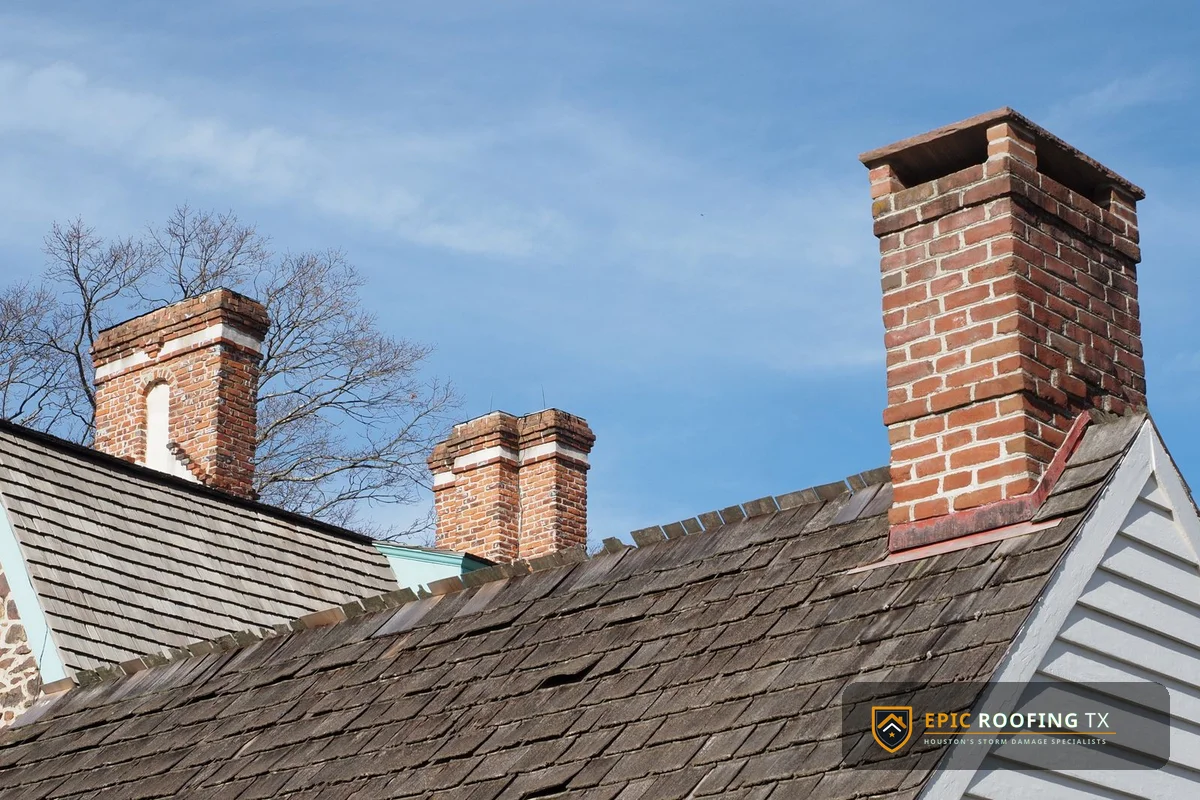
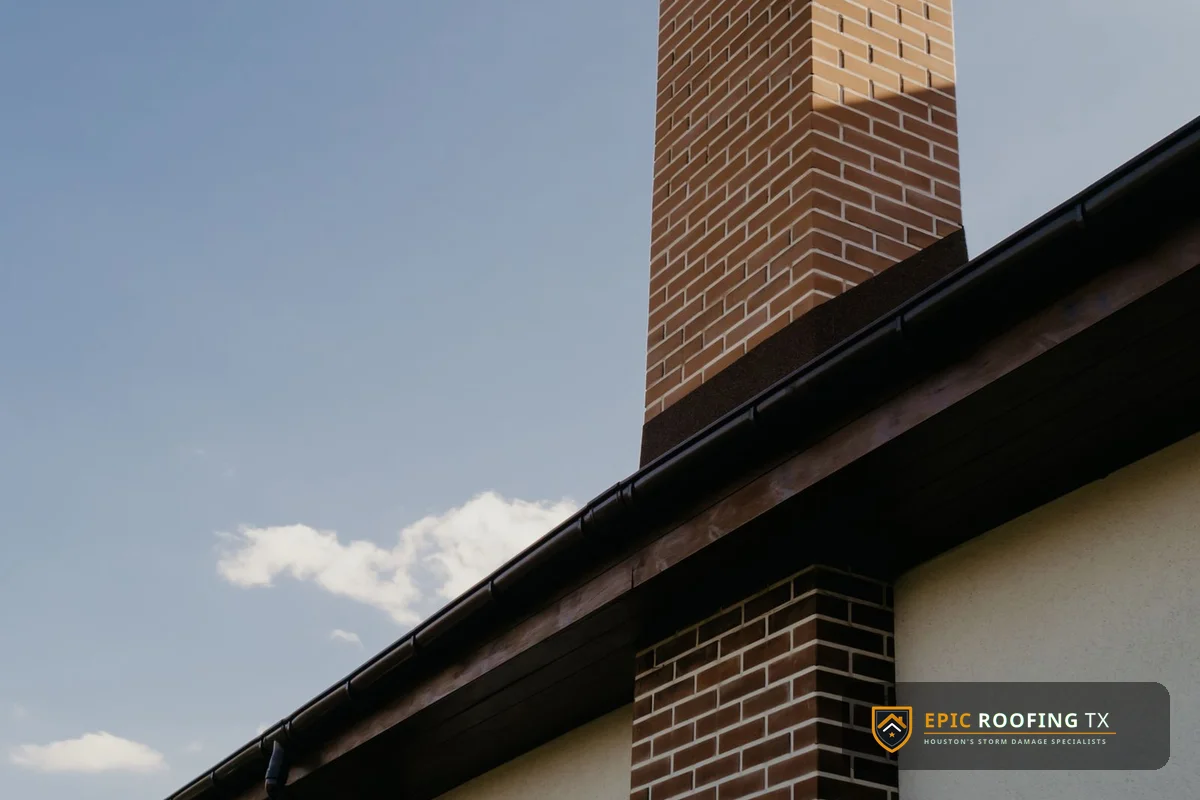
- Water stains on the ceiling near the fireplace: the classic sign. The stain rarely sits directly under the chimney — water runs along rafters first, so the mark can show up several feet away.
- Rust streaks or lifted metal at the chimney base: step flashing that has pulled away from the brick, or rust bleeding down the shingles, means the seal is open.
- Cracked or missing mortar where counter-flashing is set: counter-flashing is cut into the mortar joints. When those joints crumble, the cap loses its grip and water gets behind it.
- Damp or musty smell in the attic near the chimney: if the attic smells wet after rain and the smell is strongest by the chimney chase, flashing is the first suspect.
- Shingles lifting or curling around the chimney: heat from the stack and trapped moisture age the shingles at the joint faster than the rest of the roof.
- Debris piled against the uphill side: leaves and grit trapped behind a wide chimney hold water against the flashing and speed up corrosion — exactly what a cricket is built to prevent.
Spotted one of these? Call (281) 326-9905 — a flashing check now is a small repair; a flashing check after the ceiling caves in is not.
How Inspectors Assess Flashing Damage for Insurance Claims
Insurance adjusters frequently dismiss flashing leaks as "wear and tear." Here is how our forensic team proves storm causation.
Documenting Wind Uplift, Hail Impact & Sealant Ruptures
During severe Texas thunderstorms and hurricane-force gusts, high winds create negative pressure along the edges of chimneys and roof-wall junctions. This uplift bends thin sheet metal, pops mechanical fasteners, and tears the factory watertight seal between metal aprons and shingles.
Our Forensic roof inspectors meticulously photograph dent patterns on aluminum flashing, wind-lifted step metal, and storm-sheared counter flashing corners. We prepare engineering-grade damage reports that substantiate full replacement in your claim rather than cosmetic patches.
📑 Filing a Texas Insurance Claim? Don't let your insurance adjuster overlook thousands of dollars in hidden transition damage. Schedule a Free Roof Inspection and learn how our team guides you through the Texas Roof Insurance Claim Process.
Complete Roof Flashing & Chimney Services in Greater Houston
Custom metal fabrication on-site using heavy-gauge aluminum, galvanized steel, or copper.
Step & Counter Flashing
Individual L-shaped metal steps installed beneath each shingle course, protected by a continuous counter-flashing cap saw-cut directly into masonry mortar joints.
Chimney Crickets & Saddles
For chimneys over 30 inches wide, building code requires a custom-built ridged cricket on the uphill side to split rushing rainwater and prevent debris pooling.
Kick-Out & Valley Flashing
Precision angled diverters that kick roof runoff safely away from walls into gutters, plus heavy W-valley metal lining high-flow roof intersections.
Step Flashing vs. Counter-Flashing — What's the Difference?
Step flashing is the first line of defense: individual L-shaped pieces of metal, one per shingle course, woven into the roof as it is laid so each piece overlaps the one below it. Water running down the roof hits a step, jumps to the next, and is carried past the chimney instead of into it.
Counter-flashing is the cap over the top of it: a continuous strip of metal set into a saw-cut groove in the chimney's mortar joints, folded down over the top edge of the step flashing. It stops water running down the brick face from getting behind the step flashing. One without the other is half a job — step flashing with no counter-flashing leaves its top edge exposed, and counter-flashing with rotten step flashing underneath is a lid on a leaking box.
When either layer fails, the fix is the same: pull the shingles back, replace the metal, and reset it properly. The same two-layer logic applies wherever a roof meets a wall — see our guide to roof-to-wall flashing leaks for how that joint fails and gets fixed.
Houston Chimney & Flashing Repair Cost Guide
Transparent, upfront pricing based on chimney size, material gauge, and required structural repairs.
💵 Typical Houston Cost: Professional chimney flashing repairs range between $350 and $850 for spot resealing and step metal replacement. Complete chimney re-flashing with custom mortar reglet cuts and wood cricket fabrication averages $750 to $1,800.
| Flashing Service | Scope of Work | Average Price Range | Turnaround Time |
|---|---|---|---|
| Chimney Flashing Reseal & Reset | Remove degraded caulk, re-anchor loose counter flashing, high-grade polyurethane seal | $250 – $550 | 2 – 4 hours |
| Complete Chimney Re-Flashing | Tear off old metal, saw-cut brick reglet, install new step, apron & counter metal | $650 – $1,400 | 1 day |
| Chimney Cricket / Saddle Build | Framing custom diverter, plywood decking, ice & water shield, metal valley | $500 – $950 | 1 day |
| Roof-to-Wall Step Flashing (Per Wall) | Remove bottom shingle run, install new step metal, integrate weather barrier | $350 – $800 | Half day |
| Rotted Decking & Fascia Repair | Replace rotted 1/2" CDX plywood decking and structural rafter framing at chimney | $85 – $140 / sheet | Included in project |
What Drives Your Chimney Flashing Cost Up or Down
The ranges in the table above are the starting point — where your job lands inside them comes down to five things we find on the roof:
- Chimney width: chimneys over 30 inches wide need a cricket on the uphill side, which adds framing and metal work — and is the difference between a repair that holds and one that ponds water.
- What we find underneath: flashing jobs often uncover rotted decking or rafter framing at the chimney. Replacing a soft sheet costs extra, but covering rot with new flashing just hides the problem for another season.
- Mortar condition: counter-flashing has to be set into sound mortar joints. Crumbled joints need repointing first, or the new cap has nothing to grip.
- Material choice: heavy-gauge aluminum and galvanized steel are the standard options; copper lasts longer and costs more. The right pick depends on the roof and how long you plan to stay in the home.
- Access and pitch: a steep or two-story chimney takes longer to work on safely than a low single-story one, and that time shows up in the quote.
*All flashing installations include commercial-grade polyurethane sealants, -approved synthetic underlayment, and Epic Roofing's 10-year workmanship guarantee.
Chimney Leak or Roof Leak? How to Tell the Difference
Water on the ceiling near a fireplace gets blamed on the chimney almost every time — and half the time the chimney is innocent. Run through these checks before you pay for the wrong repair.
It Points to the Chimney When…
The stain or drip appears only after rain (not when the fireplace runs), sits on the ceiling or wall right by the fireplace, and you can see rust, lifted metal, or cracked mortar at the chimney base from the ground or the attic.
It Points to the Roof When…
The stain is feet away from the fireplace, shows up after wind-driven rain from one direction, or the attic shows wet rafters and decking well away from the chimney chase — water travels along wood before it drops.
The Test That Settles It
A hose test on the chimney flashing alone, with someone watching inside the attic: if water shows, it is the flashing. If it stays dry, the entry point is elsewhere on the roof. Our full walk-through of the method is in our guide to roof leaks near chimneys — causes and fixes.
Frequently Asked Questions About Chimney & Roof Flashing
Clear answers on identifying, repairing, and preventing roof flashing leaks in Texas homes.
Common warning signs include water stains on ceilings or walls adjacent to a chimney or vertical exterior wall, damp drywall in the attic near roof transitions, peeling interior paint around a fireplace, rusted fireplace dampers, or visible gaps and cracked caulking where metal flashing meets masonry or siding.
Flashing leaks rarely cause an immediate gushing torrent inside living areas. Instead, small trickles of water enter behind siding, chimney brickwork, or step flashing courses with every rain. This moisture travels along rafters and insulation for months unnoticed, quietly rotting the roof decking, fascia, and structural framing before water stains finally break through finished drywall.
Minor flashing resealing and spot repairs in Houston generally cost between $250 and $550. Complete chimney re-flashing—including custom cutting a new reglet into brick mortar, fabricating step and counter flashing, and installing a cricket or saddle—typically ranges from $650 to $1,600 depending on chimney size, roof pitch, and access.
Yes. Severe Gulf storms, wind shear, and hail frequently dislodge counter flashing, tear metal joints, or puncture soft metal valleys. Our forensic inspectors document storm-induced flashing displacements with high-resolution photo evidence to substantiate your insurance claim and ensure your carrier pays for complete water-tight restoration.
Get Your Free Flashing & Chimney Inspection
Schedule your on-roof forensic inspection with a specialist. Pinpoint hidden leaks before structural decking damage spreads.