
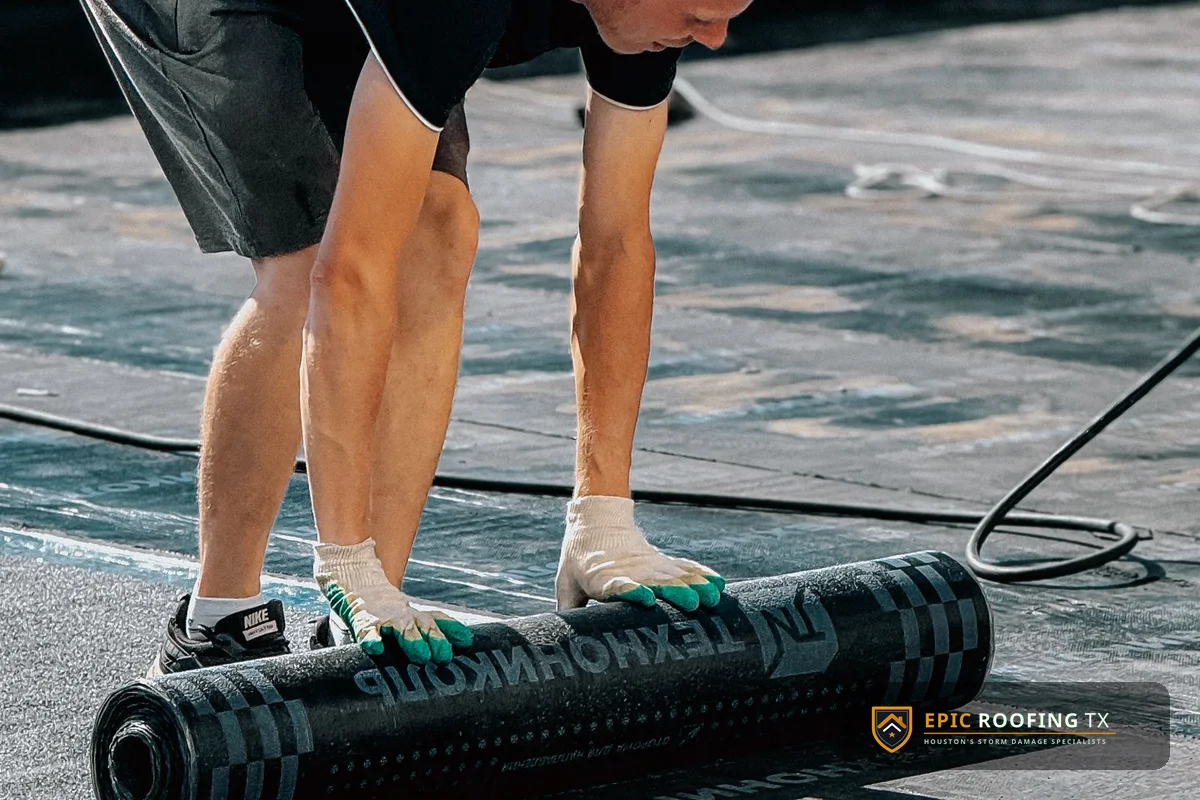
When homeowners in Houston get a roof replacement quote, most of the conversation revolves around shingles — architectural vs. three-tab, color, warranty length. Almost nobody asks about the layer underneath. That is a mistake, because underlayment is your roof's second line of defense, and in a city where afternoon humidity regularly sits above 80% and tropical downpours arrive sideways, the wrong underlayment choice shows up as deck rot, mold, and premature roof failure.
I have torn off enough Houston roofs to see the pattern firsthand: shingles that still looked decent on top, but the felt underneath had wrinkled, torn, or turned to mush — letting moisture straight into the plywood. This guide breaks down what underlayment actually does, the three main types, and how to choose the right one for a Gulf Coast home.
What Does Roofing Underlayment Actually Do?
Direct answer: Roofing underlayment is a water-resistant barrier installed directly over your roof deck and beneath your shingles. It catches any water that gets past the shingles — from wind-driven rain, lifted tabs, or ice-dam-style backup — and sheds it safely off the roof before it can soak into the wood decking.
Think of it this way: shingles are the raincoat, underlayment is the umbrella underneath. On a perfect day with brand-new shingles, you might never need it. But Houston does not do perfect days for long. Between hurricane-season gusts that lift shingle tabs, sudden microbursts, and the everyday reality of wind pushing rain uphill under shingle edges, water will find its way past the outer layer at some point. When it does, underlayment is the only thing standing between that water and your attic.
It also serves a second purpose during installation: it protects the bare deck from a surprise rain shower in the hours between tear-off and shingle installation — something that happens more often than roofers like to admit during Houston's unpredictable storm season.
Why Does Houston's Humidity Change the Underlayment Equation?
Direct answer: Houston's sustained high humidity attacks underlayment from both sides — moisture pushing up from the attic below and tropical rain hammering from above. Materials that perform fine in drier climates can wrinkle, trap moisture, or degrade faster here, which is why Gulf Coast roofers favor synthetic and self-adhering products over traditional felt.
Three local factors make underlayment selection more critical in Houston than in most U.S. markets:
- Year-round moisture load: Unlike northern climates where roofs get a dry winter break, Houston attics stay warm and humid nearly all year. An underlayment that absorbs moisture — like traditional asphalt felt — stays damp longer, which accelerates breakdown of both the underlayment and the deck beneath it.
- Wind-driven rain: Gulf storms rarely rain straight down. When 50+ mph gusts push water sideways and upward under shingle courses, the underlayment takes the full hit. A torn or poorly lapped underlayment fails exactly when you need it most.
- Blistering installation heat: Houston roof decks regularly exceed 150°F in summer. Some underlayments become difficult to install cleanly at those temperatures — wrinkling during application creates permanent channels where water can travel sideways instead of shedding off.
The 30-Second Rule for Houston Homes
If your roofer's quote just says "underlayment included" without naming the type, ask. For Houston, you want to hear synthetic underlayment on the main deck plus self-adhering (peel-and-stick) membrane in valleys and around penetrations. If the answer is "15-pound felt everywhere," get a second opinion — that specification belongs to a drier decade.
What Are the Main Types of Roofing Underlayment?
There are three categories you will encounter on residential quotes in the Houston market. Here is what each one is, honestly assessed:
1. Asphalt-Saturated Felt (Tar Paper)
The original underlayment — rolls of fiberglass or organic mat saturated with asphalt. It comes in 15-pound and 30-pound weights. Felt has been used for over a century and it is the cheapest option, which is why some budget quotes still specify it. The downsides in Houston are real: it absorbs moisture and wrinkles, tears easily in wind during installation, and degrades faster under UV if the roof sits exposed between tear-off and shingle installation. On a humid Gulf Coast roof, felt is the minimum — not the recommendation.
2. Synthetic Underlayment
Woven or spun polypropylene/polyethylene fabric — lightweight, extremely tear-resistant, and essentially waterproof. Synthetic lies flat, does not wrinkle when damp, and can typically stay exposed to weather far longer than felt if installation gets delayed by rain. It costs more than felt per roll but covers more square footage per roll and installs faster, which partly offsets the material premium. For most Houston shingle roofs today, synthetic is the standard specification.
3. Self-Adhering Membrane (Peel-and-Stick)
A rubberized asphalt membrane with an adhesive backing that bonds directly to the deck, sealing around nail penetrations as they are driven through it. This is the premium option — the only underlayment that is genuinely waterproof rather than merely water-resistant, because it self-seals. In Houston it is typically used as a supplement rather than a full-roof specification: in valleys, along eaves and rakes, around chimneys, skylights, and plumbing vents — everywhere water concentrates or flashing transitions occur.
| Feature | Asphalt Felt | Synthetic | Peel-and-Stick |
|---|---|---|---|
| Moisture resistance | Absorbs water, wrinkles | Highly resistant, lies flat | Waterproof, self-sealing |
| Tear strength | Low — tears in wind | Very high | High |
| Heat tolerance ( install ) | Wrinkles above ~120°F deck temp | Stable at high temps | Can get overly tacky in extreme heat |
| Typical use in Houston | Budget jobs only | Standard full-deck choice | Valleys, eaves, penetrations |
| Relative cost | $ (lowest) | $$ (moderate) | $$$ (premium) |
| Lifespan under shingles | Shortest in humid climates | Matches shingle life | Outlasts shingle life |
Which Underlayment Is Best for Houston Homes?
Direct answer: For a typical Houston asphalt shingle roof, the best-value specification is synthetic underlayment across the entire deck, with self-adhering membrane in all valleys, along eaves, and around every roof penetration. This combination handles Gulf Coast humidity, wind-driven rain, and installation heat without the wrinkling and moisture-absorption problems of felt.
That said, the "best" choice depends on your roof's specifics:
- Standard gable or hip roof, no complications: Full synthetic underlayment is the right call. It is the current professional standard and what most reputable Houston roofers install by default.
- Low-slope sections (below 4:12 pitch): Water drains slower on low slopes, so these areas deserve peel-and-stick coverage, not just synthetic. Many manufacturers require it for warranty coverage on low-slope applications.
- Complex roof with multiple valleys and penetrations: This is where peel-and-stick earns its premium. Every valley is a water highway; every chimney, skylight, and vent pipe is a potential leak point. Self-adhering membrane in these zones is cheap insurance.
- Home near the coast (Galveston, Clear Lake, Seabrook): Salt air plus hurricane exposure argues for maximum protection — consider extending peel-and-stick coverage along all eaves and rakes, not just valleys.
What you should not accept without question: a quote that specifies felt underlayment across the whole roof with no peel-and-stick anywhere. In 2026, on a Houston roof, that is a cost-cutting specification — not a performance one. For context on how material choices affect total project pricing, see our guide on roof replacement costs in Houston.
Where Should Peel-and-Stick Go on a Houston Roof?
Direct answer: At minimum, self-adhering membrane belongs in roof valleys, along eaves (the bottom 3 feet or so), around chimneys, skylights, and plumbing vent pipes, and along rake edges in high-wind zones. These are the locations where water concentrates, flashing transitions occur, or wind uplift is strongest.
If you take one thing from this section, make it this: valleys are the number one underlayment failure point I see on Houston tear-offs. Two roof slopes dumping water into a single channel, combined with wind pushing rain sideways, overwhelms basic underlayment fast. When I find rotted decking during a tear-off, it is in a valley more often than anywhere else — and in most of those cases, the valley had nothing but standard felt or a single layer of synthetic with no self-sealing backup.
Around penetrations, the logic is similar. Every plumbing vent, chimney, and skylight is a hole cut through your water barrier. Peel-and-stick seals tightly to both the deck and the flashing, so even if the flashing itself shifts slightly over time — which happens as Houston's heat cycles expand and contract metal — the membrane underneath keeps water out.
What Mistakes Do Homeowners Make With Underlayment?
These are the errors I see most often when reviewing other contractors' work or inspecting roofs a few years after installation:
- Never asking what type is in the quote: "Underlayment included" tells you nothing. Felt and synthetic can differ several hundred dollars on a typical Houston home — and perform very differently over 15 years of humidity.
- Skipping peel-and-stick to save money: The upgrade cost for membrane in valleys and around penetrations is small relative to a full replacement, but it is the first thing budget quotes cut. That is exactly backwards — these zones are where roofs actually leak.
- Ignoring the exposure window: If tear-off happens Monday and shingles go on Thursday, the underlayment is your roof for three days. Felt degrades quickly under Houston UV; synthetic tolerates exposure far better. Ask your roofer what happens if weather delays installation.
- Assuming thicker felt equals better: 30-pound felt is tougher than 15-pound, but it is still felt — it still absorbs moisture and wrinkles in humidity. Thicker felt is not a substitute for synthetic.
- Forgetting about existing deck condition: Underlayment goes over your decking, and if the decking is already soft or rotted from years of minor leaks, new underlayment on top just hides the problem. A proper tear-off includes deck inspection and replacement of damaged sheets — make sure that is in the scope, not just the shingle and underlayment line items.
If your current roof is showing warning signs that go beyond underlayment — curling shingles, granule loss, soft spots — review our guide on signs you need a roof replacement before deciding between targeted repairs and a full replacement.
Frequently Asked Questions
What is the best roofing underlayment for Houston's humid climate?
For most Houston homes, a high-quality synthetic underlayment across the full roof deck plus self-adhering peel-and-stick membrane in valleys, around penetrations, and along eaves offers the best defense against Gulf Coast humidity and wind-driven rain.
Is synthetic underlayment better than felt in Texas heat?
Yes. Synthetic underlayment resists tearing, wrinkling, and UV degradation far better than traditional asphalt felt in Texas heat. Felt can wrinkle when it absorbs moisture and becomes brittle faster under prolonged sun exposure during installation.
Do I need peel-and-stick underlayment on my entire roof in Houston?
A full peel-and-stick roof is usually unnecessary and significantly more expensive. In Houston, the standard approach is synthetic underlayment on the main deck with peel-and-stick applied in leak-prone zones: valleys, eaves, rake edges, chimneys, skylights, and plumbing vents.
How long does roofing underlayment last under shingles?
Underlayment is designed to last as long as the shingles above it. Synthetic underlayment generally outlasts felt because it resists moisture absorption and tearing. Its real job is serving as a secondary water barrier if shingles are ever lifted or damaged by a storm.
Internal Linking Context Table
| Anchor Text | Target Topic/Category | Placement Context |
|---|---|---|
| roof replacement costs in Houston | Cost Guide Page (/blog/roof-replacement-cost-houston.html) | Underlayment selection section linking material choices to total project pricing context. |
| signs you need a roof replacement | Replacement Signs Page (/blog/signs-you-need-roof-replacement-houston.html) | Mistakes section guiding readers to evaluate whether repairs or full replacement is appropriate. |
| free inspection | Free Inspection Page (/free-roof-inspection-houston) | Closing CTA offering a no-cost roof assessment with written material specifications. |