
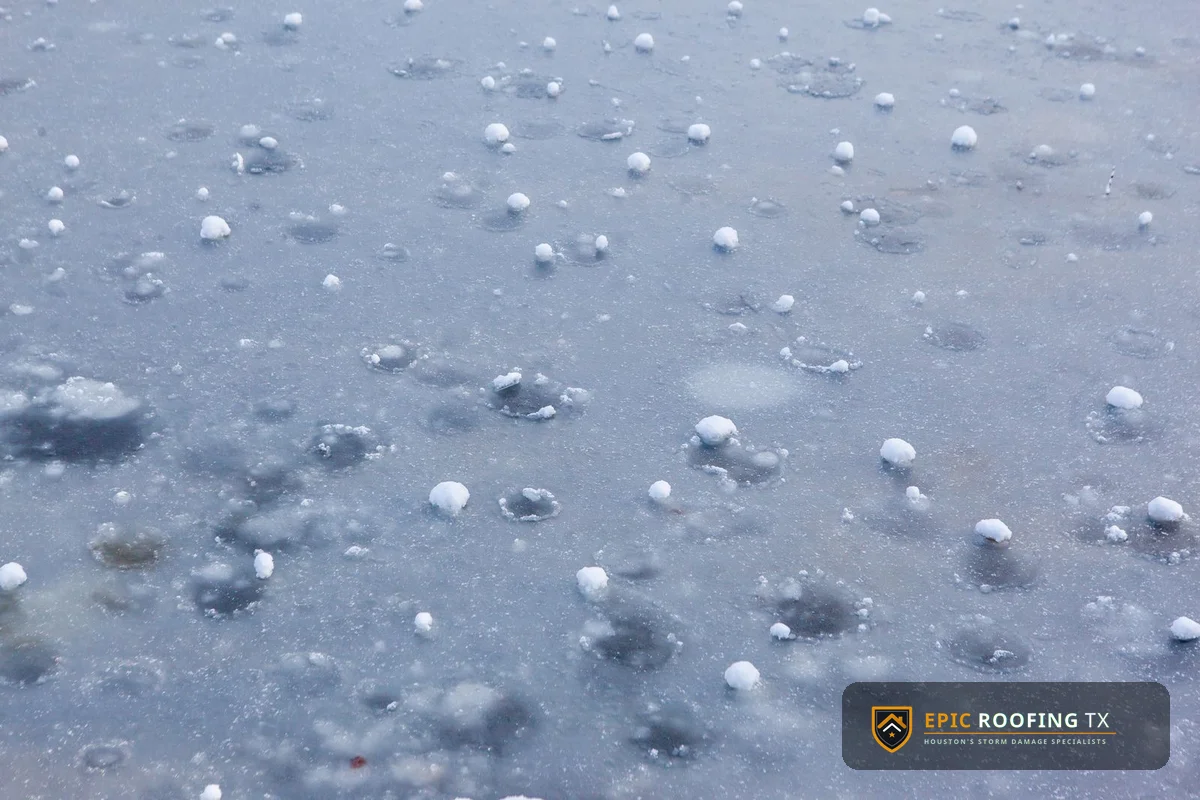
A golf-ball-size hailstone measures about 1.75 inches across and strikes at 70 to 100 miles per hour. Nothing on your roof was designed to shrug that off without a mark.
Every spring, the same scene plays out across Cypress and Spring: a hailstorm tears through at dinner time, and by morning the phones start ringing. "My roof looks okay — do I really need someone to look at it?" After golf-ball-size hail, the answer is yes. The damage hail does is mostly invisible from the ground, it quietly shortens your roof's life, and your window to document it for insurance doesn't stay open forever.
What 1.75 inches of ice does to an asphalt shingle
An asphalt shingle is a sandwich: fiberglass mat in the middle, asphalt coating around it, and a layer of ceramic granules on top. The granules are the armor — they block UV rays and give the shingle its fire rating. A hailstone strike knocks those granules loose on impact. Lose enough of them in one spot and the asphalt underneath sits exposed to the Houston sun, which bakes it brittle in a matter of months.
Harder hits do worse. The impact bruises the shingle — you can feel a soft spot, like a bruise on an apple, where the mat underneath fractured. Those bruises don't leak today. They leak in a year or two, when thermal cycling (our 100-degree days followed by 70-degree nights) works the fractured mat until it splits. I've replaced roofs in Spring where every slope was peppered with two-year-old hail bruises that had finally opened into pinhole leaks.
It's not just the shingles
Hail hits everything up there. After a golf-ball hail event, I check:
- Ridge vents and turbine vents — cracked plastic or dented metal lets rain drive straight into the attic.
- Pipe jack flashing — the rubber boots crack; the metal bases dent and lift.
- Gutters and downspouts — dents are cosmetic, but they confirm the hail was big enough to matter.
- Skylights and chimney caps — cracked seals around skylights are a leak waiting for the next rain.
- Window screens and AC fins — not roofing, but useful evidence of hail size for your claim.
Soft metals dent honestly — they don't hide damage the way granule loss can. When I walk a roof after hail, I read the vents and flashing first, shingles second.
How do insurance adjusters measure hail damage on a roof?
They use a test square: a 10-by-10-foot area marked on each slope of the roof. If an adjuster counts 10 or more hail hits inside the square on multiple slopes, that usually qualifies as storm damage. They chalk a circle around each hit, photograph the square, and repeat the count on every face of the roof.
Hail size vs. damage: a quick reference
| Hail size | Diameter | Typical roof damage |
|---|---|---|
| Pea | Under ¼ inch | Cosmetic; rarely functional damage |
| Marble | ½ inch | Minor granule loss on older shingles |
| Quarter | 1 inch | Granule loss, early bruising on aged roofs |
| Golf ball | 1.75 inches | Bruised mats, cracked vents, flashing damage |
| Tennis ball and up | 2.5 inches+ | Punctures, broken shingles, structural damage |
Why you can't judge it from the driveway
Here's the frustrating truth about hail: the worse it is for your roof's lifespan, the less it shows from the ground. A bruised shingle looks identical to a healthy one from 30 feet away. Granule loss shows up as slightly darker patches if you know what to look for — and most homeowners don't, because they're looking for holes. Golf-ball hail rarely punches holes in shingles. It wounds them, and the wounds take one to three Houston summers to become leaks.
"My neighbor's roof looks fine" means nothing, either. Two houses on the same street in Cypress can take the same storm and come out differently — shingle age, slope direction, and even tree cover change how hail energy lands. The only opinion that counts is from someone who walked your slopes and chalked your test squares.
Thinking ahead: shingles built for the next storm
If your roof does need replacement after hail, ask about Class 4 impact-resistant shingles. They're tested under UL 2218 — a standardized impact test where steel balls are dropped onto shingles from set heights — and Class 4 is the highest rating a shingle can earn. They cost more upfront than standard architectural shingles, and many Texas insurers offer premium discounts for them, which helps offset the difference over time.
No shingle is hail-proof. But there's a meaningful difference between a roof that bruises in every spring storm and one that takes the same hit and keeps its granules. If you're replacing anyway, it's worth the conversation.
Does golf-ball-size hail always mean I need a new roof?
Not always. It depends on the roof's age, the shingle type, and how many hits the test squares show. A five-year-old architectural roof might survive with minor granule loss, while a 16-year-old roof — near the end of the 15–20 year Houston lifespan — hit by the same storm could be done. That's why an inspection matters more than hail size alone.
After the storm: document before you clean up
Before anything else, write down the date and approximate time of the storm, save a few hailstones in your freezer in a labeled bag, and photograph dents on your car, gutters, and AC unit — they're timestamped proof of hail size. Then get a storm damage inspection. Most policies give you a limited window to file, and waiting too long gives the carrier room to argue the damage came from wear, not weather.
If the inspection confirms widespread hits, our help with insurance claims can walk you through filing. Remember: most homeowners pay only their insurance deductible, and anyone offering to waive it is breaking Texas law under House Bill 2102. And if all you need is a few bruised shingles swapped out, our roof repair team handles that too.
Frequently Asked Questions
My roof is only 6 years old. Can golf-ball hail really damage it?
Yes. Age helps, but 1.75-inch hail carries enough energy to bruise even new architectural shingles. Younger roofs survive better — the mats are more flexible and the seal strips hold — but I've marked qualifying test squares on five-year-old roofs in Spring. Get it checked; a young roof with documented hail damage is also the easiest claim you'll ever file.
How long do I have to file a hail damage claim in Texas?
Most Texas homeowners policies require you to file promptly — typically within one year of the storm, though some policies allow two. The practical answer is sooner: granule loss and bruising are easiest to document fresh, and carriers get skeptical when a "hail claim" arrives eighteen months after the last storm. Don't wait.
Will my insurance go up if I file a hail claim?
In Texas, insurers generally can't single you out for a rate hike over a weather-related claim — hail is legally considered an act of God, not your fault. That said, area-wide rates can rise after a big storm season regardless of whether you personally file. The damage is already priced into your zip code; the claim just gets your roof fixed.
Can hail damage be repaired, or does it always need replacement?
Small, localized hail damage can sometimes be repaired — a handful of bruised shingles on one slope, for example. But hail rarely hits one slope evenly, and manufacturers generally don't warranty patchwork on impact-damaged roofs. When test squares qualify on multiple slopes, replacement is the standard outcome, and it's what your policy is designed to cover.